You invested in the experiment. You built the libraries. Then the Cell Ranger output arrived and the data sat there, waiting for someone who understands the biology.
I am a cell biologist with 70+ publications who runs scRNA-seq from raw output to paper-ready story. Not 500 genes in a table. Figures reviewers can eva.
Most single-cell datasets follow the same trajectory. The experiment works. The libraries are clean. The sequencing core delivers a Cell Ranger output. And then the data waits, sometimes for months, because nobody in the group has time to turn it into biology.
Technical bioinformaticians can run the pipeline. That is not the bottleneck. The bottleneck is the layer between the pipeline output and the paper: which markers actually validate your annotation, which resolution reveals the biology you are looking for, which integration method preserves the signal you need, and how to write the story so that it survives peer review.
That layer is what I deliver. Every algorithmic step carries a biological decision. I make those decisions with twenty years of cell biology behind them, and I document each one so your team can defend it.
A senior molecular biologist, head of a molecular biology department at a major research institute in Southeastern Europe, invested in 10X Chromium and successfully generated her libraries. When the Cell Ranger output arrived, her team had no one who could translate it into biological interpretation. The available support focused on pipelines and gene lists, but the missing layer was the biological story.
I took the raw data. Within three weeks she had quality-controlled cell populations, integrated across samples, cell-type annotated with marker validation, differential expression tied to her research question, and a coherent narrative with publication-ready figures.
When an external single-cell expert reviewed the results independently, the interpretation held. The dataset stopped being a problem and became a manuscript.

Every cluster is annotated with validated markers and explained in terms of what it means for your research question. The output is a narrative, not a spreadsheet.
UMAP, dotplots, heatmaps, trajectory plots, composition charts, sized and formatted for your target journal. TIFF at 300-600 dpi or vector PDF/SVG. Palette and typography matched to your manuscript.
Full R or Python notebook with pinned environment. Your team can rerun every step, inspect every parameter, and extend the analysis after delivery.
Written for your manuscript. Every analytical choice justified so that reviewers can check it.
The analysis anticipates the questions reviewers will ask. Quantitative validation of annotation. Justified resolution. Documented integration choice. Fewer revision rounds.
You have a dataset and are not sure what to do with it. We spend an hour on a call, then I send a written analysis plan: what question the data can answer, which approaches fit, what the scope and timeline look like. You leave knowing exactly what comes next, whether you continue with me or with someone else.
You have a partial analysis and one piece is missing or not working. Sample integration. Cell-type annotation. Trajectory inference. Differential expression interpretation. I take that component, deliver the result with a notebook and biological interpretation, and hand it back so your team can continue.
Raw Cell Ranger output in, publication-ready analysis out. QC, integration, annotation with marker validation, differential expression, biological interpretation, publication figures, methods paragraph. Everything needed to submit. This is the engagement most clients need.
For groups with ongoing single-cell work. Six to eight hours a month of analysis review, manuscript feedback, strategy conversations, and quality control before results go to reviewers. A standing second opinion from someone who has published 70+ papers.
All prices in USD. EUR invoicing available. Exact quote after scoping, before any work begins.

Pinned environments. Fixed random seeds. Documented parameters. Your team can rerun everything I deliver and get the same result.

Most single-cell analysts learned the tools first. I learned the biology first, over twenty years and 70 publications, and then the tools. The difference shows in every annotation decision.

Cell-type annotation is checked against canonical markers quantitatively, not just visually. When the annotation is wrong, I find it before your reviewers do.

I use AI tools to accelerate technical execution. Every biological decision, every interpretation, every quality check is mine. I will tell you exactly which is which.
Cell-type annotation agreement with expert-curated labels on a multi-patient tumor atlas, after independent re-analysis. The disagreements were biologically interpretable, not random.
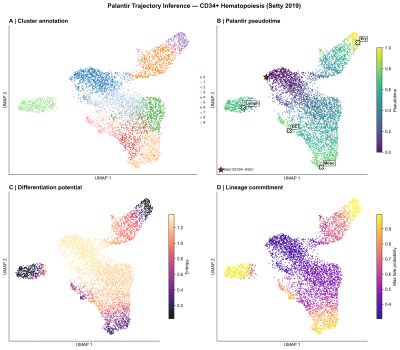
Pseudotime correlation with a published developmental trajectory in hematopoiesis. The biology reproduces.
Clustering concordance on a four-state glioblastoma framework, tested across two sequencing platforms. The cell states are real, not platform artifacts.
Reproducible analyses covering integration, annotation, trajectory, RNA velocity, and cell-cell communication. Every one has code, environment, and quantitative validation.

Your data (raw counts, Cell Ranger output, a Seurat or AnnData object, or a GEO accession), your biological question, and your target journal if you have one.
Within three working days you get a written scope: what the data can answer, which tier fits, exact price, and timeline. No work starts before you approve.
Quality control, integration, annotation, interpretation. You receive interim results at defined checkpoints so nothing surprises you at the end.
Figures, methods, and narrative iterated until submission-ready. Revision rounds are included in the scope.
Not answered here? Email me at [email protected]
No. That is the most common starting point. Data does not expire. Send what you have and I will tell you what it can still become.
A technical bioinformatician runs the pipeline and delivers outputs. I run the pipeline and deliver interpretation. The difference is whether you receive a table of differentially expressed genes, or an explanation of what those genes mean for your hypothesis, with figures that show it.
Yes, and I consider it an advantage. AI accelerates technical execution. It does not know whether your marker is valid in your tissue, whether your integration is hiding biology, or whether your story will survive review. Those judgments are mine, and I document which is which.
Both. Tell me which ecosystem your lab uses and I deliver in it.
Yes. Your data is handled privately and never reused. NDA on request.
For most engagements, no. This is a professional service. Authorship is discussed separately if my contribution to the scientific question is substantial, and it does not replace the fee .
Yes. Public dataset re-analysis, including comparison against original findings, is part of what I do.
Marko Živanović, PhD in Cell Biology (Masaryk University). Principal Research Fellow, Institute for Information Technologies Kragujevac. 70+ peer-reviewed publications, h-index 24.
I entered single-cell analysis not through a course but through a dataset that had to become a paper, under deadline, with no one else available to do it. I learned what matters by having to make it work. Now I do that for others.
ORCID: 0000-0002-8833-8035
We use cookies to analyze website traffic and optimize your website experience. By accepting our use of cookies, your data will be aggregated with all other user data.